
Rhino Conservation

- Their Future is in our hands -

Rhino Conservation

A portion of the proceeds of Ka’roo products goes towards conserving the rhino populations of South Africa.

The Problem

We are in the midst of an unprecedented poaching crisis in Africa. Driven by ever-increasing demand from growing Asian markets (particularly in China and Vietnam), poachers are killing three or more rhinos per day in southern Africa. Poaching syndicates, mostly based in Mozambique, but some within South Africa, are well-equipped, highly-organized and dangerous – they use helicopters, machine guns, veterinary immobilization drugs and other sophisticated methods to stalk rhinos.

By the end of 2016, 1,054 rhinos had been killed by poachers in South Africa alone, slightly fewer than the 1,175 rhinos slaughtered for their horns in 2015.  About two-thirds of the killing has taken place in Kruger National Park, which shares 221 porous miles of its 621-mile border with Mozambique.  However, as Kruger as ramped up its security, poachers have turned to other targets within South Africa, such as KwaZulu Natal and Eastern Cape Province, as well as to neighboring countries such as Zimbabwe and Namibia.
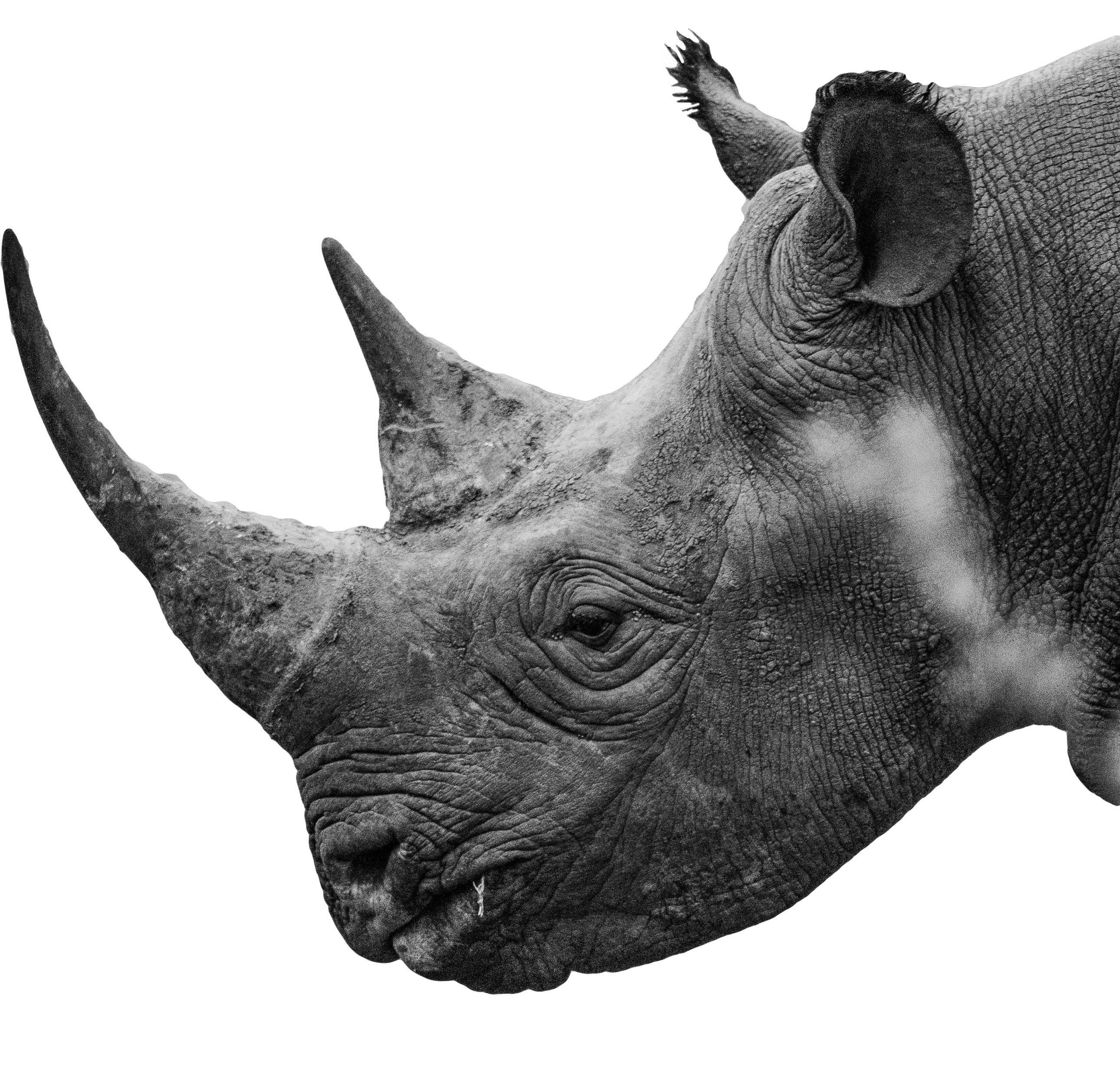
Why Rhinos Matter

Rhinos have been around for millions of years and play a crucial role in their ecosystem. They’re important grazers, consuming large amounts of vegetation, which helps shape the African landscape. This benefits other animals and keeps a healthy balance within the ecosystem.

Local people also depend on the natural resources within rhino habitat for food, fuel and income. As one of Africa’s ‘big five’, rhinos are a popular sight for tourists. Ecotourism can be an important source of income for local people.

By helping protect rhinos, we’re helping to conserve their habitat for the benefit of people and wildlife, helping support local communities and making sure natural resources are available for generations to come.

The African Rhino

Black Rhinoceros

Also, know as the hook-lipped rhinoceros (Diceros bicornis), it is critically endangered. It is native to South, Central and Eastern Africa. There are three remaining subspecies, Diceros bicornis minor, found in South Africa and Zimbabwe, Diceros bicornis bicornis, found in Namibia and Diceros bicornis Michaeli, found in East Africa. The western black rhinoceros is the most recent subspecies to be declared extinct by the IUCN. The black rhinoceros is a herbivorous browser that eats leafy plants, branches. The preferred habitat us dense scrub and woodlands. The rhinoceros has poor eyesight but hears very well. The gestation period is about 16 months and calves remain with their mothers for two to three years. The black rhinoceros is the more aggressive of the two species.

The African Rhino

White Rhinoceros

The name white rhinoceros is derived from the Dutch word “wijd”, which means wide and refers to the wide mouth of the animal which is used for grazing. These are two subspecies, the southern white rhinoceros, Ceratotherium simum simum, which is the most numerous of the species and the northern white rhinoceros, Ceratotherium cotton, of which only three remain in the world. Their preferred habitat is open grassland. The majority (93%) of white rhinos occur in South Africa. The southern white rhino is the most numerous of all the rhinoceros species and recovered from less than 100 animals in the early 1900’s to about 18 000 today, thanks to efforts by people like Dr Ian Player. White rhinos are semi-social animals and can congregate in groups of six or more animals know as “crashes”. A rhino can live to approximately 40 years.

rhinos at alzu petroport

How can you help?

Be aware, report and donate.
The RhODIS project depends heavily on the public support.

Donations:

Bank: ABSA
Account Number: 214 00 000 35
Account Name: University of pretoria
Branch: 33 55 45 (Hatfield)
Reference: RhODS_ADW756 3600

Fax or e-mail proof of payment to:

vgl@up.ac.za or 086 5788 337

Please be aware and contact the following numbers if you notice any suspicious activity near parks or farms where rhinos are found:

SANPark Control Room Skukuza: 013 735 0197
Crime Line: Send an anonymous SMS to 3 22 11
Crime Stop: 08 600 10 11